In this issue...
- First live NockApp demo with on-chain settlement of $NOCK
- First official NockApp SDK (v1) launching this week
- Bridge to Coinbase’s Base chain on target for December 4
- Three new technical overviews of the Nockchain system
Dear readers,
It's been a little while since we've been shipping aggressively ahead of the Christmas season...
For your convenience, here's a succinct roundup of the latest developments since we last wrote you for the first Protocol Upgrade around October 24!
Looking ahead, we're getting ready to launch our bridge to Coinbase’s Base chain. This will make wrapped $NOCK available in the Base mobile app, making it much easier for the world to access. More details on that soon.
Shipped: First Programmability Features
Programmability primitives on Nockchain now include lock scripts and arbitrary data attachments, enabling Hash Time Locked Contracts (HTLCs) for atomic swaps. Segregated Witness (SegWit) decouples signatures from transaction data, optimizing onchain storage and allowing script commitments to remain hidden until execution. Hashing the public key also provides a layer of privacy, as the full key is not revealed until a note is spent. A modular architecture now permits opcode additions without forcing future hard forks. Programmability Begins.
Shipped: The First NockApp
We shipped our first open-source, user-facing NockApp demo, which we ran live on mainnet with real $NOCK.
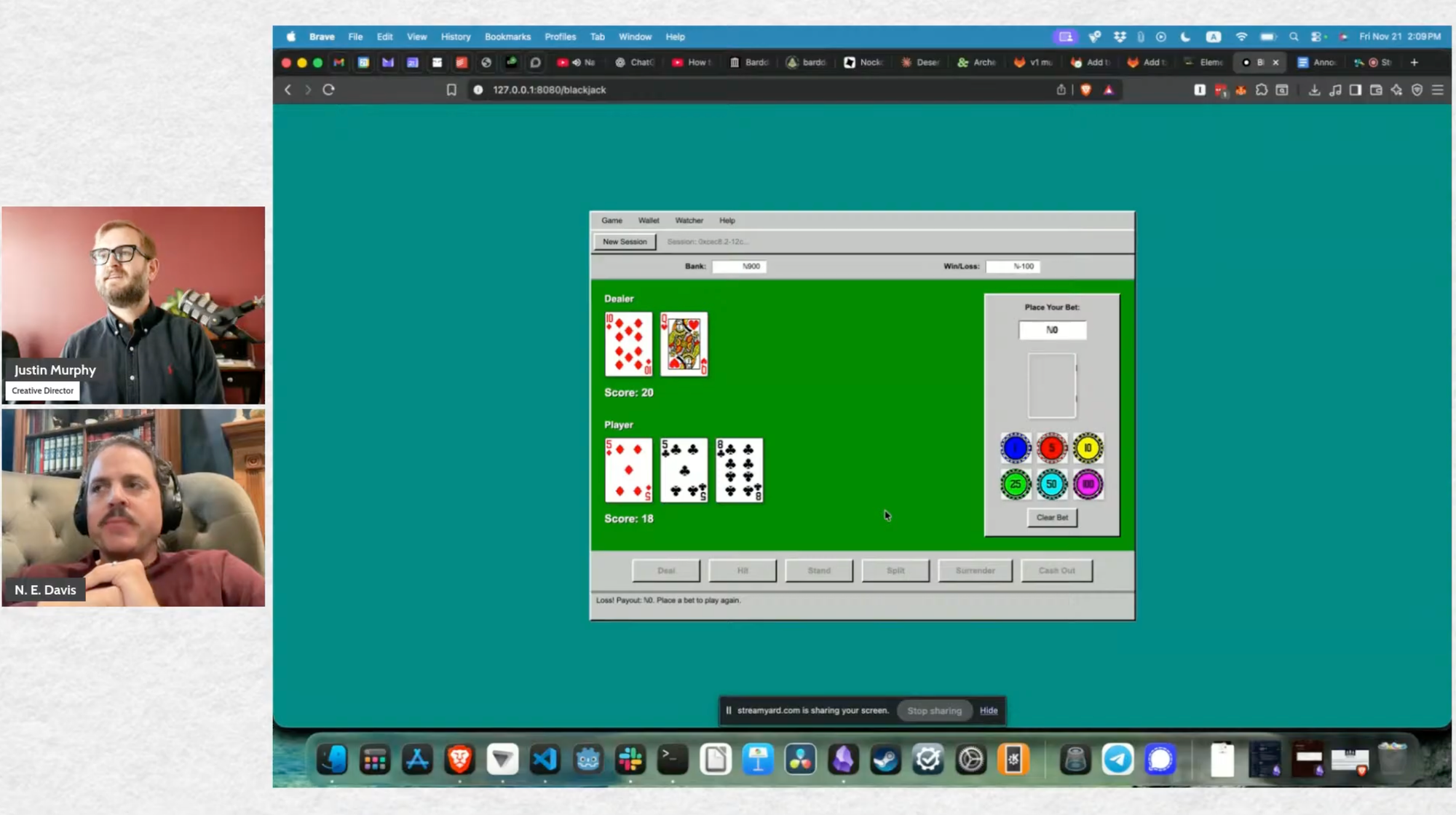
The demo app implements a complete Blackjack game (with a nostalgic Windows ‘95 aesthetic, of course). Players place bets by clicking chip icons. Deal cards, hit, stand, and watch your bankroll update in real time. Under the hood, the application uses a view/state/controller architecture:
- Front-end (HTML/CSS/JavaScript) provides the user interface and client-side rendering.
- Hoon implements server-side game logic, session management, and HTTP routing via Gall agents.
- Rust provides the HTTP driver for the NockApp runtime, with caching fixes to properly serve different resources per URI. Transaction driver interfaces with the Nockchain to post cash-in and payout transactions.
 sigilante
View the Github repo.
Shipped: New Block Explorer API
We released a gRPC API that makes it easier to build wallets, explorers, and analytics without running a full node. Announcement, code.
GetBlocks: paginated block retrieval with IDs, heights, parents, timestamps, transaction IDs.GetTransactionBlock: find the block for a tx or confirm if it’s pending.GetTransactionDetails: full input/output details, amounts, fees, and status.
Shipped: Multisig Support for Nockchain Wallet
Nockchain Wallet Multisig Update. Nockchain wallet commit 50c9ed3 introduces multi-signature transaction support and watch-only synchronization. Users define M-of-N spending conditions via JSON recipient specifications. The system validates thresholds and prevents address duplication before the Hoon transaction builder constructs on-chain lock scripts.
Nockchain Repo Moved to Independent Foundation
Nockchain Takes Major Step Toward Decentralized Governance. Zorp transferred ownership of the Nockchain repo to the Nockchain Foundation. Merge authority and commit access now distribute across multiple independent entities: Zorp, NockBox, and Southwestern Pool Supply Co.
Engineering Deep-Dive #1
The Nockchain Consensus Model. Nockchain implements Nakamoto consensus via a Zero-Knowledge Proof-of-Work (ZKPoW) protocol. Nodes identify the canonical chain by accumulated proofpower rather than block height. Miners solve ZK puzzles containing transaction sets and headers, propagating solutions via bidirectional libp2p connections. Succinct proofs allow watchers to verify current state without historical data.
Engineering Deep-Dive #2
The Nockchain ZK-PoW Puzzle. Nockchain implements Zero Knowledge Proof of Work (ZKPoW) to transform mining into useful transaction verification. The puzzle requires miners to populate a balanced binary tree with Goldilocks field elements derived from the previous block. Miners generate a zero-knowledge proof of this subject; the hash must meet a difficulty target that updates every two block-weeks.
Engineering Deep-Dive #3
Building Sovereign Applications with NockApp. The framework employs a two-component architecture: a Rust Runtime manages I/O, while a Nock ISA Kernel handles logic as a pure function. This "solid-state" model rejects databases; state exists solely as a binary tree of unsigned integers. Unlike rollups relying on dispute periods, NockApp utilizes an intent-based model where off-chain solvers generate zero-knowledge proofs.
Next Up: NockApp SDK and Base Bridge
We’re excited to welcome new users and developers as $NOCK soon becomes available via the Base mobile app. This will be a major step toward much broader access and interoperability for Nockchain.
That's all for this week! If you have any questions or comments, hit reply.
We're also active in the Telegram.